
How to Evaluate a Kitchen Equipment Supplier in Malaysia: Site Visit Checklist, Quotation Review, and Installation Planning
When fitting out or upgrading a restaurant, cafe, bakery, hotel kitchen, or central kitchen, the supplier you choose affects far more than price. A strong supplier helps prevent layout and utility mistakes, coordinates delivery and installation, and reduces downtime. A weak one can leave you with equipment that cannot access the site, overloads your electrical supply, or fails food-safety workflow needs.
This tutorial shows how to evaluate a kitchen equipment supplier Malaysia buyers are shortlisting using practical steps: pre-qualification, a structured site visit, quotation review, and installation planning—so you can compare options fairly before paying a deposit.
Step 1: Pre-qualify the supplier before you book a site visit
Do a quick pre-check first to filter out suppliers who cannot support your project scope (new setup, replacement, or expansion).
1) Confirm the supplier matches your kitchen category
Match your menu and service style to what the supplier can consistently provide and support:
- Refrigeration: upright chiller/freezer, undercounter chiller, display chiller, ice machine.
- Cooking line: open burners, griddle, deep fryer, pasta boiler, salamander, rotisserie.
- Bakery: mixers, proofers, baking ovens, toasters.
- Prep & production: vegetable cutters, grinders, mincers, slicers, sealing/packing equipment.
- Stainless steel workstations: sinks, worktables, racks, counters, trolleys, custom fabrication.
If you have a front counter or beverage station, confirm they routinely supply and install items like a beverage display fridge or display chiller as part of an end-to-end plan, not delivery only.
2) Ask the three “capability proof” questions
- After-sales support: Who troubleshoots, and what is the response workflow (remote vs. site call-out)?
- Installation scope: Do they install and commission, or only deliver?
- Custom work: If you need stainless steel sized to your layout, do they fabricate in-house or outsource?
Most commercial kitchen risk sits at the interfaces: equipment-to-utility connections, equipment-to-drain points, and equipment-to-stainless integration.
3) Decide early if you are considering new, used, or rental
Using used commercial kitchen equipment or short-term rental can reduce initial capex, but only if condition and support are clear. If used units are on the table, plan to inspect and test them and verify utility compatibility (see Step 3).
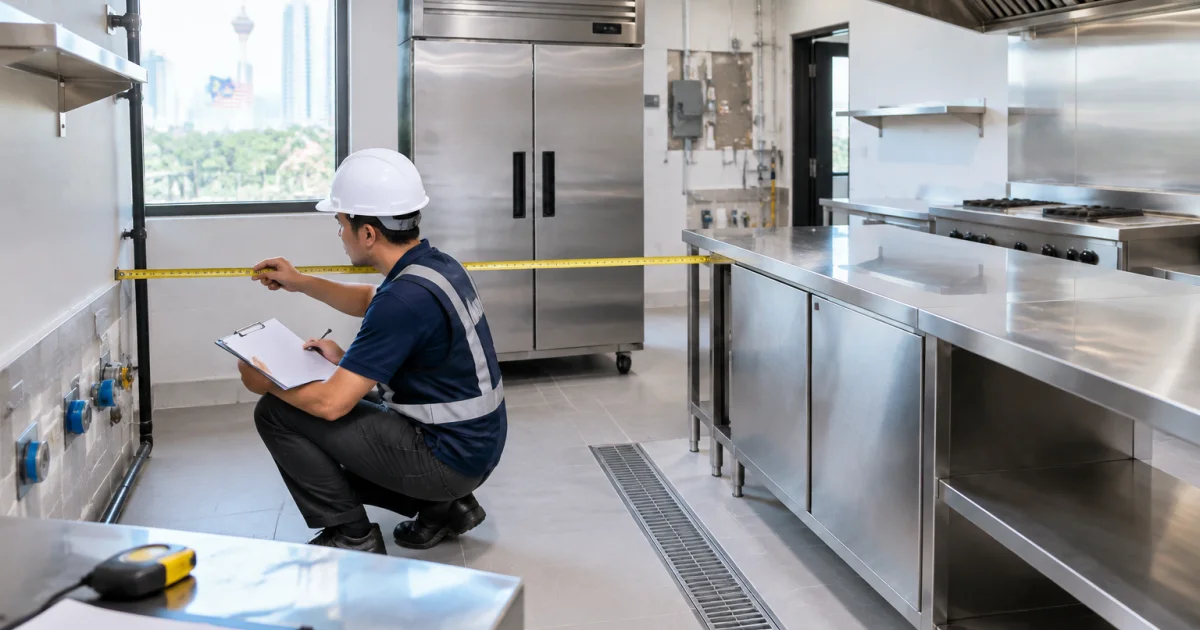
Step 2: Run a structured site visit (walkthrough + measurement checklist)
Treat the site visit as a technical survey. The goal is a layout-confirmed equipment list and a utilities plan that supports safe workflow and maintenance access.
Bring these documents (even if they are rough)
- Simple floor plan with approximate dimensions (a hand sketch is fine).
- Menu and peak output assumptions (covers/hour, batch size, catering volume).
- Equipment wish list (must-have vs. nice-to-have).
- Photos/videos of entrances, stairs/lift, corridors, and the service route.
Site visit checklist: 10 areas to confirm on the spot
- Access and delivery path: Measure door widths, turns, lifts, and steps. Confirm handling needs for large items (upright chillers, ovens).
- Equipment placement and clearances: Confirm operating clearance (doors/drawers), service access, and ventilation gaps.
- Utility points mapping: Mark electrical, water inlet, drainage, and gas points. Quotes should reference real positions, not assumptions.
- Electrical load reality check: List each item’s power requirements and single-phase vs. three-phase needs; flag likely distribution board limits for your electrician to confirm.
- Drainage and floor gradient: Verify floor traps and drain routes for sinks, ice machines, combi/steamers, and any equipment needing discharge.
- Heat, smoke, and ventilation: For fryers/griddles/open burners, confirm hood length, extraction planning assumptions, and make-up air considerations.
- Workflow and food safety zoning: Check the flow: receiving → storage → prep → cook/bake → pass → wash-up, including handwash and dishwashing zones.
- Refrigeration strategy: Validate whether you need an upright chiller, counter chiller, or display chiller. For front-of-house, ask about lighting, glass, and condensation in humid conditions.
- Stainless steel fabrication measurements: Confirm steel grade preferences, backsplash height, shelves, edge finishing, and equipment cut-outs/sit-on/sit-under plans.
- Noise and customer-facing impact: Ask about likely noise for beverage chillers/ice machines and discuss placement if customers are nearby.
What “good” site visit outputs look like
Before you move to quotation, request a written summary that includes:
- a proposed equipment list (model-by-model where possible),
- layout notes or a rough placement plan,
- a utilities requirement list (power, water, drain, gas), and
- an installation scope statement (supplier vs. your contractor).
If you are comparing suppliers for kitchen equipment Penang or multi-state rollouts, insist on the same outputs from each supplier to keep comparisons consistent.
Step 3: Review quotations like a buyer, not like a shopper
Do not compare totals only. Compare what is included, excluded, and assumed so you can avoid surprises after you commit.
Build an “apples-to-apples” comparison table
Ask each supplier to quote against the same line items. If they propose alternatives, require a written reason and performance/utility differences.
| Line item | Brand/model | Qty | Included scope | Exclusions/assumptions | Warranty/support notes |
|---|---|---|---|---|---|
| Upright chiller/freezer | Specify | 1 | Delivery, positioning | Power point by others | Parts/labour terms |
| Display chiller / beverage display fridge | Specify | 1 | Delivery, leveling | Condensation management? | Service response process |
| Stainless worktable/sink | Custom | 1 | Fabrication, installation | Site measurement included? | Lead time |
Quotation checklist: what must be written (not implied)
- Exact equipment identification: model/series, key specs, and included accessories (trays, racks, casters, shelves).
- Delivery details: delivery location, unloading method, timing constraints, and whether moving upstairs/lift access is included.
- Installation and commissioning: leveling/anchoring, test run, refrigeration temperature set-up, and ignition/burn-in checks where applicable.
- Utility connection responsibility: who provides plugs/isolators, gas regulators/hoses, water filters, and drainage connections.
- Site preparation requirements: floor loading, wall reinforcement, hood readiness, and required clearances.
- Warranty and after-sales: duration, coverage, response procedure, and common exclusions (wrong voltage, poor ventilation, misuse).
- Training/handover: basic operator briefing for critical equipment (ovens, mixers, processing machines).
How to evaluate used or second-hand equipment quotes safely
If the quote includes used units (including second hand stainless steel kitchen equipment), add these requirements:
- Condition disclosure: photos, serial plate details, and known defects listed up front.
- Inspection and testing: functional tests (cooling performance, motor operation, blade alignment) before acceptance.
- Parts availability: confirm wear-and-tear parts and repair support.
- Installation fit: verify voltage, drainage, and clearance as strictly as you would for new equipment.
Used can work as a bridge for new outlets or seasonal demand, but only when the supplier supports it as a product—not a “sell and forget” item.
Step 4: Plan installation like a mini-project (timeline, roles, and risk controls)
Even good equipment can underperform if installation is rushed. Strong suppliers coordinate details, sequencing, and communication.
Define roles early (RACI-light)
- Supplier: deliver, position, install/commission as quoted, and provide handover.
- Your contractor: M&E works, extraction hood, floor traps, cabinetry interfaces, and finishing works.
- Your team: provide access and storage space, attend training, and do final sign-off.
Ask the supplier to state pre-delivery requirements in writing (power points, water inlet location, drainage readiness, hood installed, clearances met).
Create a simple installation timeline (example sequence)
- Pre-install confirmation: finalize measurements for custom stainless steel and confirm delivery route.
- Utilities readiness check: verify power, water, drain, gas, and extraction are ready.
- Delivery and positioning: place heavy items first, then stainless workstations, then smaller prep equipment.
- Connection and commissioning: connect, test, calibrate, and verify basic functions.
- Handover and punch list: record defects/missing accessories/adjustments and agree a resolution timeline.
Installation red flags that should pause your decision
- They refuse a site visit but still quote a “final” installation price.
- They cannot state lead times for custom fabrication or key imported items.
- They avoid putting inclusions/exclusions in writing.
- They promise performance without checking ventilation, drainage, or power capacity.
Step 5: Make the final supplier decision with a scorecard
When pricing is close, use a scorecard to keep decisions commercial and consistent. Weight criteria based on your concept and uptime risk.
Suggested scoring criteria (customize your weights)
- Technical fit: specs match your output and menu.
- Site-readiness accuracy: they identified utility gaps and space constraints early.
- Quotation clarity: scope and assumptions are explicit; minimal surprise add-ons.
- Installation capability: defined commissioning and handover process.
- After-sales support: response workflow and spare parts approach.
- Flexibility: ability to mix new/used/rental or trade-in if needed.
For multi-site operations, prioritize standardization: consistent models across outlets simplify training, spare parts, and maintenance routines.
Useful next reads (to support your shortlist)
- Browse commercial cooking equipment categories to validate menu fit.
- Check deep fryer options if frying output is central.
- Review pasta boiler selections for consistent peak-hour portioning.
- Explore rotisserie equipment for display cooking and high-volume roasting.
- Compare griddle, char broiler, and open burner setups to match ventilation and menu needs.
Conclusion: evaluate the supplier the same way you evaluate the kitchen
Evaluate suppliers with the same discipline you use to plan your kitchen: document requirements, measure the site, and make scope explicit. Pre-qualify capabilities, run a structured site visit to confirm access and utilities, and review quotations using an apples-to-apples table so responsibilities are clear. Then plan installation as a mini-project with roles, sequencing, and a punch list.
Do this well and you will reduce surprises, protect your opening timeline, and end up with a kitchen that is easier to operate and maintain.
Frequently Asked Questions
What should I check during a site visit with a commercial kitchen equipment supplier?
Confirm delivery access (door widths, turns, lifts), exact equipment placement and service clearances, utility points (power, water, drainage, gas), ventilation readiness, and workflow zoning (storage → prep → cook → wash). Ask the supplier to provide a written utilities requirement list and installation scope after the visit.
How do I compare quotations from different kitchen equipment suppliers fairly?
Use an apples-to-apples comparison table: same line items, stated model/specs, and written inclusions/exclusions. Make sure delivery, installation/commissioning, utility connection responsibilities, and warranty/support terms are clearly documented. If a supplier proposes an alternative item, require them to explain performance differences and any impact on utilities or ventilation.
Is it safe to buy used commercial kitchen equipment in Malaysia?
It can be safe when the supplier discloses condition clearly and supports the sale. Request functional testing (cooling performance for chillers, motor operation for mixers, blade alignment for slicers), confirm parts availability, and ensure your site utilities match the equipment (voltage, drainage, clearances). Avoid deals where the unit cannot be tested or where the scope is “as-is” with no support process.
What should be included when ordering custom stainless steel kitchen equipment fabrication?
Your quotation should include a site measurement visit (or confirmed dimensions), stainless steel grade and thickness assumptions, drawings or at least written dimensions, finishing details (edges, backsplash, undershelf), cut-outs for equipment, and installation/anchoring scope. Also confirm lead time and what happens if on-site dimensions differ from initial sketches.
How far ahead should I plan delivery and installation for a new kitchen setup?
Start planning once your shortlist is ready and before you pay a deposit. Build a simple timeline covering final measurements, utilities readiness checks, delivery route confirmation, installation/commissioning, and a punch-list handover. The right timing depends on your renovation scope and whether you have custom fabrication or imported items, so insist the supplier states realistic lead times in writing.
Need a supplier-led site assessment and a clearer quotation?
Pearlmile supports Malaysian F&B businesses with one-stop commercial kitchen solutions—commercial refrigeration, cooking equipment, bakery machinery, food processing machines, and custom stainless steel fabrication. If you are shortlisting suppliers, we can help you structure a practical site visit, clarify utilities and layout requirements, and scope delivery, installation, and after-sales support so your quotation is easier to compare.