
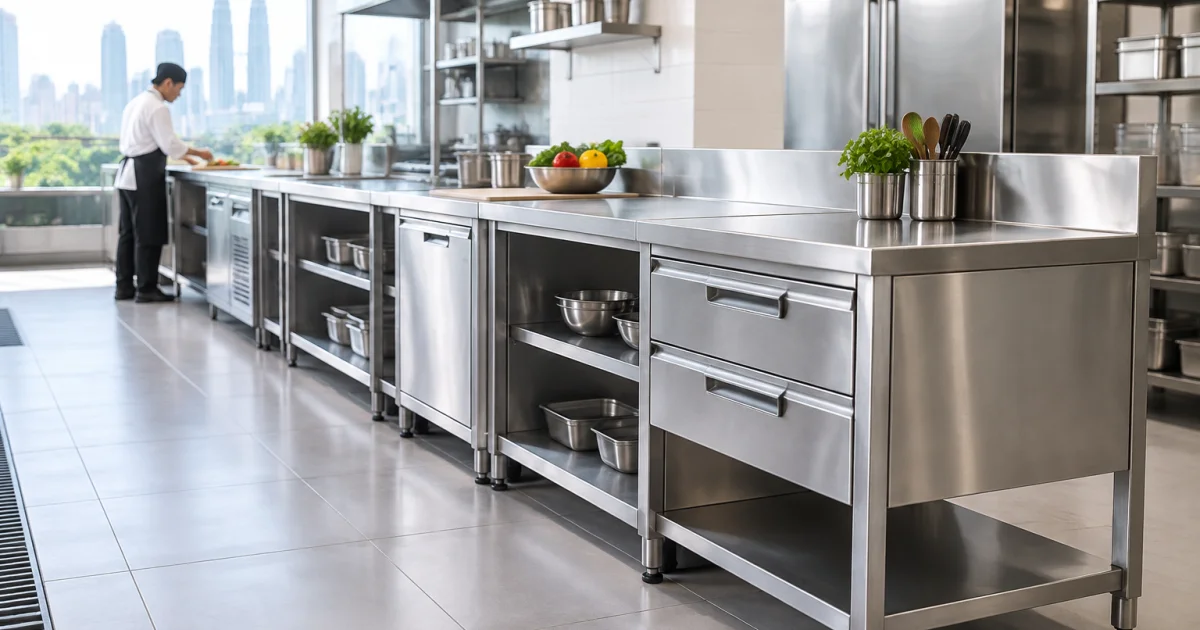
Commercial Stainless Steel Work Tables in Malaysia: 2026 Design Trends for Compact Kitchens and High-Volume Prep
In a busy kitchen, the work table is where time is won or lost. For Malaysian restaurants, cafes, bakeries, hotels, caterers, and food factories, stainless steel work tables have become workflow tools: they can reduce wasted motion, keep tools within reach, control mess, and help teams hit prep targets without expanding the footprint.
This matters even more in 2026 because many operators are balancing compact kitchen layouts (especially kiosks, food stall counters, and back-of-house spaces squeezed by rising rental pressure) with higher output expectations (delivery, catering, batch prep, and multi-brand concepts). As a result, the “default” table is being replaced by modular, spec-driven builds that match how your team actually works.
If you’re searching for a stainless steel working table Malaysia suppliers can fabricate to your exact line flow, this article walks you through the most common design trends, the specs that influence durability and hygiene, and a practical checklist you can use to request a quote with fewer revisions.
1) 2026 trend: Modular workstations that replace single-purpose tables
Instead of buying one table for prep and another for storage, many operators now request workstation-style builds that combine surface + storage + accessory mounting in one footprint. The goal is to minimize steps and keep prep tools staged where they’re used.
What “modular” usually means in real kitchens
- Undershelf or mid-shelf for trays, mixing bowls, dry goods bins, or small appliances.
- Drawer sets for knives, tongs, scoops, tape, labels, and thermometers so staff don’t walk to a separate cabinet.
- Raised overshelf (where suitable) for plating items, containers, or POS peripherals in compact service lines.
- Accessory rails and hooks for frequently used tools to reduce clutter on the top surface.
For compact kitchens, modularity is less about “adding parts” and more about reducing the need for extra furniture. When you combine functions correctly, you can open up aisle clearance and create cleaner handoff points between stations.
Practical example: Two-table footprint becomes one
A small cafe that used to run a separate prep table + a storage rack can often shift to a single worktable with a full undershelf and a 2–3 drawer stack. The top stays clear for sandwich prep, while backups (wraps, gloves, smallwares) live below. That means fewer cross-aisle trips and fewer items stacked on the surface where they collect crumbs and spills.
2) 2026 trend: Compact-kitchen layouts driving custom depths, corner use, and pass-through lines
Standard sizes are still popular, but requests for custom dimensions are increasing because operators want every centimetre to serve a purpose. Compact kitchens are not only “small”; they’re often irregular—columns, existing sinks, floor traps, and refrigeration lines affect usable space.
Common layout-driven requests
- Shallower depths along narrow aisles to maintain safe two-way movement during peak periods.
- Corner worktables to convert dead corners into usable prep zones or staging for trays.
- Pass-through prep lines where food moves in one direction: receiving → wash → prep → cook → plate/pack.
- Left-hand / right-hand orientation for drawers, sink bowls, or cut-outs so the station matches your actual handoff direction.
Even in high-volume environments, compact efficiency is a theme: the less staff rotate, backtrack, or reach across each other, the more consistent your output becomes.
Actionable step: Map your “reach zones” before you order
Before requesting fabrication, stand at the station location and note what must be within one arm’s reach: knives, boards, bins, sauces, scales, wrap film, and towel dispensers. Then decide what should be on the top, what should be below, and what can be mounted. This simple map reduces redesign loops later.
3) 2026 trend: Hygiene-first detailing—fewer dirt traps, easier wipe-downs
Stainless steel is inherently popular for its cleanability, but the details determine whether a table stays easy to sanitize after months of service. In 2026, many buyers are asking specifically for features that reduce “dirt traps” and speed up end-of-shift cleaning.
Details operators are specifying more often
- Seamless or tightly finished joints on corners and undershelves to reduce grime build-up.
- Turned-down edges or safe hemmed edges to avoid sharp corners and make wiping faster.
- Backsplash options (where the table sits against a wall) to help contain splashes and prevent items slipping behind.
- Rounded internal corners in integrated sink or bowl areas for easier scrubbing.
These features are especially valuable in pastry and bakery prep, where powders and fats get into seams, and in beverage stations, where syrups and condensation create sticky residue.
Practical example: Dough and pastry station
A bakery dough station often benefits from a slightly higher backsplash and fewer horizontal ledges behind the worktop. That keeps flour from packing into small gaps and reduces the time required to clean the wall junction. Pairing this with a well-supported undershelf keeps heavy mixing bowls stable and off the floor.
4) 2026 trend: More integrated functions—sinks, bins, and equipment cut-outs
Operators want fewer handoffs between separate pieces of stainless steel kitchen equipment Malaysia kitchens rely on. Worktables are being ordered with integrated components so staff can prep, rinse, drain, and stage in one station.
Popular integrations
- Integrated bowl sink or inset sink cut-out for quick rinse tasks, especially in beverage and dessert lines.
- Drop-in ice well / ingredient bin cut-outs (common in drinks prep and cold assembly).
- Holes or grommet-style cut-outs for cables and small appliances (sealers, scales, label printers) to keep cords tidy.
- Undercounter equipment clearance planned for items like small chillers, warmers, or compact machines.
Integration reduces the number of separate stands and carts. It also improves consistency: tools and ingredients always return to the same home position, which supports faster training for new staff.
Where to be careful
Integrated cut-outs lock you into certain equipment dimensions. If you plan to upgrade machines later (for example, a larger sealer or a different beverage dispenser), ask for a little tolerance or a modular insert approach. A good supplier can help you plan the cut-out so you don’t end up re-fabricating after a menu expansion.
5) 2026 trend: Storage and staging built for high-volume prep (not just “extra shelf”)
High-volume prep has a different rhythm than à la carte service. It needs staging space for containers, ingredient tubs, GN pans, trays, and sometimes packaging. The 2026 approach is more intentional: buyers are designing worktables around the containers they actually use.
What’s changing in storage design
- Full-length undershelves sized to hold commonly used tubs and trays without stacking too high.
- Drawer partitioning (even simple dividers) to prevent tools from becoming a mixed pile.
- Two-tier staging using overshelves or raised racks to separate “clean tools” from “in-use ingredients”.
- Open access vs. doors: many prep areas still prefer open undershelves for speed, while some operators prefer partial shielding to reduce dust and splash exposure near wash zones.
For catering and central kitchens, staging is a throughput issue: every time your team has to hunt for a lid or relocate trays because there’s no landing space, output drops.
Practical example: High-volume packing line
A packing line for delivery can use a long table with a dedicated “packaging zone” at one end (tape, labels, bags in drawers), a central “portioning zone” (scales, containers), and an “outgoing zone” with a rack or clear landing space. Even if the table is one continuous top, dividing it into zones reduces cross-traffic and mistakes.
6) 2026 trend: Durability specs buyers ask about more—top thickness, bracing, and leg stability
When tables fail, it’s rarely because “stainless steel isn’t durable.” It’s usually because the specification didn’t match the load, the usage pattern, or the floor conditions. In 2026, more buyers are asking for clarity on construction details, especially when they run heavy prep tasks (meat processing, large dough batches, bulk vegetable cutting, or equipment-mounted stations).
Key durability specs to discuss with your supplier
- Worktop thickness and reinforcement: heavier tasks benefit from a top that doesn’t oil-can (flex) under pressure.
- Under-top bracing: important for long spans, equipment vibration, or when staff lean/press during prep.
- Leg and frame design: stable legs reduce wobble, which improves knife work safety and reduces fatigue.
- Adjustable feet: useful for uneven floors and to maintain drainage direction near wet areas.
You don’t need to overbuild everything. The more cost-effective approach is to specify reinforcement only where the task demands it: heavy equipment zones, long tables, and stations that take repeated impact.
Actionable step: List your heaviest “real loads”
Write down what actually sits on the table during peak operations: a mixer bowl, a meat mincer, a vacuum sealer, stacks of GN pans, or a cutting block. Then tell your supplier whether staff will be pounding, kneading, slicing, or pressing. This information helps them recommend the right bracing and frame without guessing.
7) 2026 trend: Finish, look, and front-of-house crossover (open kitchens and counters)
Stainless worktables are no longer hidden. With more open-kitchen concepts and compact stall-style businesses, stainless surfaces are often visible to customers. That’s driving increased attention to finish consistency, neat edges, and clean integration with surrounding counters.
Where appearance and function meet
- Cleaner weld finishing and more uniform brushing so the station looks intentional in open views.
- Front panels or modesty panels to conceal under-shelf storage when the station faces customers.
- Counter-to-table continuity so a food stall counter and prep table feel like one system, not mismatched pieces.
This is especially common for beverage and dessert concepts where the “prep” is part of the customer experience. If your worktable is part of a service counter, consider how staff access storage without exposing clutter to the front line.
Practical example: Beverage station with visible prep
A drink prep station might combine a worktop for sealing and garnish prep, a cut-out for bins, and drawers for cups/lids—then add a clean front panel to keep the station looking organized during rush hour. In these setups, the table is both equipment and branding support (through neatness and consistency), without needing signage on the unit itself.
8) How to order the right worktable: a 10-point spec checklist (and common mistakes)
Trend awareness is useful, but BOFU buyers usually need something more practical: a way to request the right build, quickly, from a commercial kitchen equipment supplier Malaysia operators can rely on for accurate fabrication.
Your 10-point checklist for requesting a quote
- Exact dimensions (L × W × H), plus tolerance if it must fit between walls or equipment.
- Station role: prep, packing, wash support, pastry, meat/veg processing, plating, or beverage.
- Placement: against wall, island, corner, or pass-through line (impacts backsplash and access).
- Worktop requirements: flat top, turned edges, cutting board placement, or heat considerations near cooking equipment.
- Storage plan: open undershelf, mid-shelf, drawers (how many, which side), or overshelf.
- Integrations: sink bowl, holes for tap, cut-outs for bins, cable holes, or equipment clearance below.
- Load and use pattern: heavy equipment, pounding/kneading, constant wet use, or fast wipe-down requirements.
- Floor reality: drain direction, uneven tiles, wet zones (adjustable feet help).
- Workflow direction: left-to-right vs right-to-left, number of staff sharing the station.
- Future-proofing: planned menu expansion or equipment upgrade that could change cut-outs or storage needs.
Common mistakes to avoid
- Buying “standard size” without checking aisle clearance. A few centimetres can be the difference between smooth movement and constant bumping.
- Overloading an unbraced long table. Flex causes wobble, noise, and premature fatigue in joints.
- Placing drawers where knees collide for staff who work close to the edge.
- Skipping backsplash in splash-prone zones (near sinks, beverage prep, or sauce-heavy stations).
- Designing without considering cleaning access behind and under the unit.
If you’re building or refreshing a full line, it’s also worth thinking about the broader stainless steel kitchen equipment Malaysia operators often combine with worktables: racks, sinks, trolleys, and custom counters. A coordinated layout can reduce duplicated spending and make installation faster.
Useful next steps: related stainless fabrication categories
If you want to compare workstation options or add matching pieces, these Pearlmile categories can help you explore configurations before requesting a custom build:
- Stainless steel fabrication categories for tables, counters, sinks, and custom builds.
- Worktable rack options if you need added vertical staging in a compact kitchen.
- Bowl sink table selections for rinse-and-prep integration.
- Food stall & tea counter builds if your worktable needs to double as a service counter.
- Stainless steel components for add-ons and customization elements.
Conclusion: Use 2026 trends to buy a table that matches your workflow
The 2026 direction is clear: commercial stainless steel work tables in Malaysia are being treated as engineered stations, not generic furniture. Compact kitchens are pushing modular storage, custom sizing, and integrated functions, while high-volume prep demands better staging and more thoughtful durability specs. Meanwhile, hygiene-focused detailing and front-of-house visibility are raising expectations for clean finishing and easy wipe-down design.
To make the right purchase, don’t start with “What’s the cheapest table?” Start with “What job must this station do, all day, with my team and my layout?” When you can describe the task, placement, storage needs, and real loads, a capable supplier can fabricate a worktable that saves time every shift and lasts through heavy service.
Frequently Asked Questions
What should I specify when ordering a custom stainless steel work table for a compact kitchen?
Provide the exact space constraints (wall-to-wall measurements, doorway widths, and aisle clearance), the station purpose (prep, packing, beverage, wash support), and which side staff will approach from. Then specify storage (undershelf, drawers, overshelf), any integrations (sink bowl, cut-outs, cable holes), and whether the table sits against a wall (backsplash) or is an island. The clearer your workflow and placement, the fewer revisions you’ll need during fabrication.
Is it worth adding drawers and undershelves to a commercial worktable?
For most high-activity stations, yes—if the storage matches what staff actually use. Undershelves keep heavy items off the floor and free up nearby racks. Drawers reduce walking time and keep tools organized, especially in compact kitchens. The key is to avoid overloading the station: assign a storage purpose (tools, packaging, backups) so the top remains a true working surface.
How do I choose between new and used commercial kitchen equipment in Malaysia for prep stations?
Worktables are often cost-effective to buy new because you can match dimensions and integrations to your layout, and hygiene detailing is critical. Used equipment can make sense for certain items if they’re inspected, structurally sound, and easy to clean. A practical approach is to buy new for custom stainless fabrication (worktables, counters, sinks) and consider inspected used units for budget support where fit and condition are acceptable.
Can a stainless steel kitchen equipment fabrication shop build worktables with sink bowls and cut-outs?
Yes. Many fabrication shops can integrate bowl sinks, tap holes, drain positioning, ingredient-bin cut-outs, and undercounter clearance into a single workstation. To avoid fit issues, share your sink size, tap location preference, plumbing constraints, and any equipment dimensions that must sit under or on the table.
How do I pick a reliable commercial kitchen equipment supplier in Malaysia for stainless worktables?
Look for a supplier that can explain material and construction choices clearly, offers measurement guidance, and can fabricate to suit your workflow (not only sell standard sizes). Ask how they handle delivery and installation, what after-sales support is available, and whether they can provide matching stainless components (racks, sinks, counters) so your kitchen line stays consistent.
Ready to build a better prep station with Pearlmile?
Pearlmile supplies and fabricates commercial stainless steel worktables, racks, sinks, counters, and complete stainless solutions to match real Malaysian kitchen workflows. Whether you need a compact workstation with drawers, a high-volume prep line with staging, or a stall counter that doubles as service frontage, we can help you choose the right specs and build to your layout.
Talk to Pearlmile for a practical recommendation based on your space, menu, and daily load—plus delivery, installation, and after-sales support when you need it.