
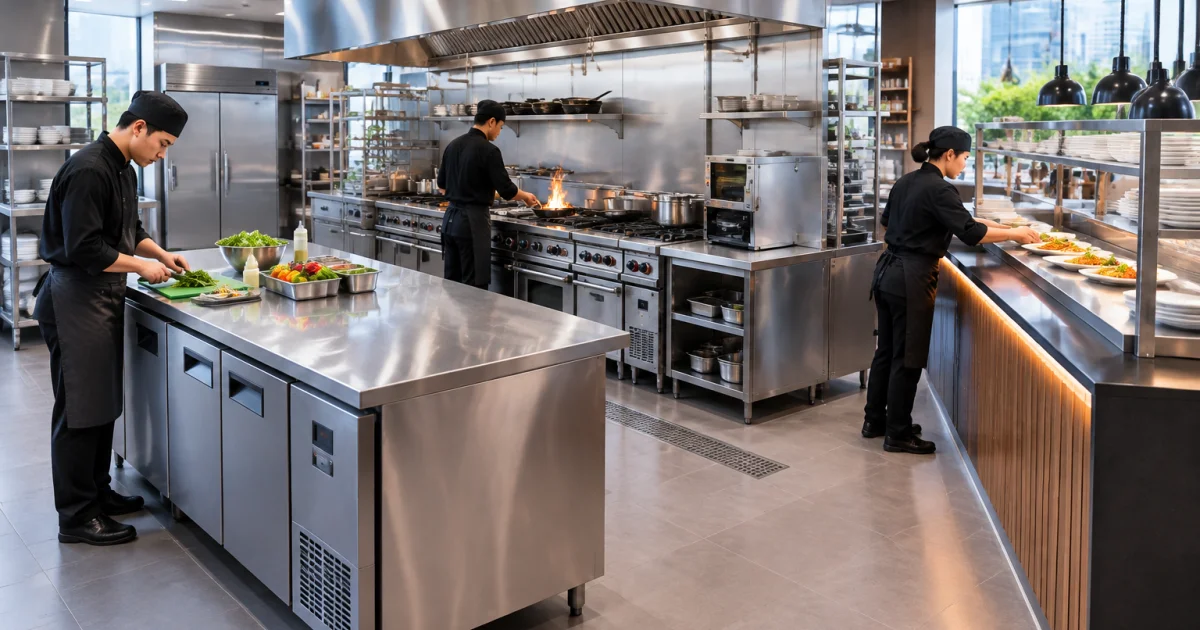
How to Choose and Layout Commercial Kitchen Equipment in Penang for Faster Service Flow
Fast service flow is rarely about “working harder”. In most Penang kitchens, speed comes from a layout that prevents cross-traffic, protects the cold chain, and keeps high-use tools within one or two steps.
This tutorial walks through a practical sequence to select and arrange commercial equipment so your team can prep, cook, and serve with fewer handoffs and less backtracking. If you’re comparing kitchen equipment Penang suppliers or planning a renovation, follow these steps before committing to purchases, stainless fabrication, or electrical points.
Step 1: Define your service flow (before you buy anything)
Equipment selection gets easier when you first decide how food and people should move. Sketch a one-direction path from receiving to service, then place equipment around it.
Map the 6 kitchen zones
- Receiving & storage: deliveries, dry store, chilled/frozen holding
- Pre-prep: washing, peeling, cutting, portioning
- Cold prep: salad/sandwich/dessert assembly, garnish, plating support
- Hot line: cooking line (wok, fryer, range, griddle, oven)
- Pass & service: final assembly, heat holding, pickup
- Dishwashing: soiled drop, wash, dry, clean storage
A faster layout keeps clean and dirty paths from colliding. If cooks and servers constantly cross lanes or turn around to find ingredients, ticket times and errors rise.
List menu-driven “stations”
Build your equipment list station-by-station (not from a catalog): nasi kandar line, grill, noodle station, bakery production, drinks counter, and so on. Each station needs a micro-flow: ingredients in → prep/cook → plate → pass.
Practical check: For your top 10 best-sellers, note where each item is (1) stored, (2) prepped, (3) cooked, and (4) plated. Long walks between steps signal a layout fix.
Step 2: Choose the right equipment capacity for your peak hour
Oversized machines waste space and power; undersized equipment creates bottlenecks that staffing can’t solve. Capacity planning prevents peak-hour pileups.
Start with your peak-hour output targets
Estimate the maximum portions you must produce per hour at full load, then translate it into station capacity:
- Hot line: simultaneous portions (burners, fryer baskets, griddle width, oven trays)
- Prep: kg per hour (worktable length, mixer size, vegetable cutter output)
- Cold holding: chilled stock within reach (undercounter vs upright; display chiller for FOH)
If you run drinks or desserts, plan front-of-house flow too. A beverage display fridge near the counter can reduce trips to the kitchen and keep high-margin items visible.
Decide what must be new vs what can be used
- Usually worth buying new: critical food-safety and uptime items (main refrigeration, core cookline equipment, key electrical safety components)
- Often good used candidates: some stainless worktables/racks, selected warmers, certain prep machines if inspected and serviced
Used equipment can help during renovations, new concept testing, or as backup capacity. Treat it like a project: verify condition, parts availability, and after-sales support.
Step 3: Build a layout that reduces steps and avoids cross-traffic
With stations and capacity set, design the line to keep tasks within efficient reach while maintaining clear aisles and safe separation (raw vs ready-to-eat; clean vs dirty).
Use three guiding layout patterns
- Assembly line: prep → cook → pass for high-volume, consistent menus
- Zone kitchen: multiple stations around a central pass (grill + wok + fryer + salad/dessert)
- Galley layout: two parallel lines for narrow shoplots (prep one side, cook the other)
Many Penang shoplots suit galley or zone layouts. If space is tight, protect a straight path from cold storage → prep → cookline, and keep dishwashing away from the pass.
Place refrigeration where it saves the most time
Refrigeration placement drives walking distance. Instead of one large chiller at the back, use right-sized storage plus point-of-use chilling:
- Upright chiller/freezer: bulk storage near receiving or prep
- Undercounter chiller: high-frequency ingredients under prep tables or near the hot line
- Display chiller/display refrigerator: drinks/desserts near service areas without disrupting production
When sourcing from a commercial display refrigerator supplier in Malaysia, confirm door swing clearance and ventilation needs—often the difference between a smooth fit and a cramped aisle.
Design your cookline as a single “workline”
Arrange hot equipment to match sequence: cold ingredients → cooking → finishing → pass. A typical order:
- Landing/prep space (heat-safe table or stainless counter)
- Primary cooking (open burners, wok range, char broiler, griddle)
- Fry/boil support (deep fryer, pasta boiler, stock pot area)
- Finishing (salamander, hot holding, heat lamps if used)
- Pass counter (final check, garnish, pickup)
Keep the pass close enough that cooks don’t carry plates through traffic. If servers enter the kitchen, give them a single pickup point to avoid weaving through stations.
Step 4: Plan stainless steel fabrication to fit your workflow (not the other way around)
Stainless fabrication turns the drawing into a workable kitchen. Done well, it creates landing space, closes unusable gaps, and keeps tools and ingredients organized.
Decide which pieces should be custom-made
Custom work is most valuable for irregular dimensions or integrated functions (storage + sink + prep + equipment base). Common custom items include:
- Prep tables with undershelves or ingredient rails
- Pass counters sized to plating style and ticket volume
- Sinks positioned to reduce raw-to-ready cross-contamination
- Racks and trolleys matched to your tray and pan sizes
If you’re evaluating stainless steel kitchen equipment fabrication, share more than measurements: station tasks, peak-hour load, and cleaning routines. This helps fabricators recommend details like upstands, splash guards, rounded corners, and practical shelf spacing.
Use a “landing space” rule
Every heat appliance and every sink needs landing space beside it for hot pans, drained items, and washed utensils. Missing landing zones create clutter and delays.
- Next to fryer: draining, seasoning, packing
- Next to steamer/boiler: baskets, ladles, tray swap
- Next to sink: separate dirty drop and clean air-dry
When second-hand stainless makes sense
Some operators choose second hand stainless steel kitchen equipment for neutral items like tables and racks. It can work if:
- Welds are intact and surfaces aren’t deeply pitted
- Edges/corners are safe and easy to clean
- Dimensions match aisle widths and station heights
Allow time for modifications (cut-outs, shelf changes, reinforcement) so fabrication doesn’t delay opening.
Step 5: Validate utilities, compliance needs, and maintainability
A layout can fail if utilities and service access are ignored. Before final POs, confirm power, water, drainage, ventilation, and servicing clearances.
Create an equipment schedule (a simple table works)
| Station | Equipment | Footprint | Utilities | Clearance/Access |
|---|---|---|---|---|
| Prep | Undercounter chiller | W×D×H | Power | Front ventilation, door swing |
| Hot line | Fryer / range / griddle | W×D×H | Gas/Power | Service access, hood coverage |
| Wash | Sink + dishwasher (if any) | W×D×H | Water/Drain | Dirty/clean separation |
Complete this for every major item. Clearances prevent expensive rework later (ventilation gaps, door swing, hood coverage, and access panels).
Design for cleaning and preventive maintenance
- Leave space to mop behind lines, or use sealed bases where appropriate
- Avoid placing refrigeration where condenser coils clog easily
- Place floor drains where wet work happens (wash zone and some prep tasks)
- Use racks and trolleys to reduce floor clutter
If you’re mixing new and used commercial kitchen equipment Malaysia options, confirm spare parts and service support for each major brand/model to avoid long downtime.
Step 6: Source smart—evaluate supplier support, not just product lists
Two kitchens can buy similar machines and get different results. Supplier guidance—layout checks, installation coordination, and after-sales support—often makes the difference.
Questions to ask before buying
- Can you help check my layout and workflow? Look for feedback on door conflicts, missing landing space, and risky cross-traffic.
- Do you provide delivery and installation? Coordination matters when multiple items arrive across different dates.
- What support is available after installation? Understand response time, coverage, and parts sourcing.
- Do you offer trade-in or rental? Helpful for phased upgrades or temporary peak capacity.
If you operate beyond Penang, a kitchen equipment supplier Malaysia that supports both equipment and stainless fabrication can reduce “handover gaps” where nobody owns the final fit and finish.
Useful next reads (equipment categories and planning examples)
- Browse commercial cooking equipment options to build a coherent hot line.
- Explore foodservice equipment such as warmers and holding solutions for a faster pass.
- See beverage equipment ideas to reduce back-and-forth during service.
- Consider a bain marie for controlled holding in buffet or high-turnover menus.
- View a Penang equipment setup project to see workflow and storage in practice.
Conclusion: A faster kitchen is a layout decision first
To speed up service, start with workflow, size equipment for peak hour, then lock in a layout that protects one-direction movement. Use point-of-use refrigeration, build a single coherent cookline, and invest in stainless fabrication where it removes bottlenecks and adds landing space. Finally, validate utilities and service access before purchasing.
Follow the steps in order to avoid common mistakes: buying machines that don’t fit the menu, placing equipment that forces cross-traffic, and discovering too late that doors, drains, or ventilation don’t match the plan.
Frequently Asked Questions
Is it worth buying used commercial kitchen equipment in Malaysia for a new Penang outlet?
It can be, especially for neutral or non-critical items (some stainless tables/racks, selected warmers, certain prep machines) if they are inspected, tested under load, and supported with available spare parts. For critical food-safety and uptime items like core refrigeration and main cookline equipment, many operators prefer new units or professionally refurbished units with clear service support.
What’s the best commercial kitchen layout for faster service in a narrow shoplot?
A galley layout (two parallel lines) often works best in narrow spaces: keep prep and refrigeration on one side, hot cooking on the other, and a dedicated pass/pickup point at the end. The key is a clear aisle, minimal cross-traffic with servers, and placing high-use ingredients in undercounter chilling near the stations that need them.
How do I choose a beverage display fridge without slowing down operations?
Choose based on where it will be used. For front-of-house, prioritize visibility, fast door access, and capacity that matches peak demand. For back-of-house, prioritize fast restocking and easy cleaning. Always confirm door swing, ventilation clearance, and whether the unit’s footprint blocks staff movement at the counter or pass.
When should I consider stainless steel kitchen equipment fabrication instead of off-the-shelf items?
Consider custom fabrication when your space has tight or irregular dimensions, when you need integrated functions (prep + sink + storage), or when landing space is missing around cooking and washing areas. Custom pieces are also useful for pass counters and racks that must match your tray sizes, workflow, and cleaning routine.
What should I look for in a commercial kitchen equipment supplier Malaysia businesses rely on?
Look beyond product availability. A strong supplier can review your workflow and layout, advise on sizing, coordinate delivery and installation, provide after-sales support, and offer options like trade-in, rental, or used equipment. These services reduce delays and costly rework during opening or renovation.
Need help planning a faster Penang kitchen layout? Talk to Pearlmile
Pearlmile supports Penang and Malaysia F&B operators with one-stop commercial kitchen solutions: refrigeration, cooking equipment, bakery machinery, food processing machines, foodservice equipment, and custom stainless steel fabrication. If you’re upgrading, opening, or redesigning for faster service flow, our team can help you shortlist the right equipment mix, review practical placement, and arrange delivery, installation, and after-sales support—including new, used, rental, and trade-in options.