
Custom vs Off-the-Shelf Stainless Steel Kitchen Equipment in Malaysia: Where Each Option Wins
Choosing between standard catalogue stainless and custom fabrication can look like a style decision, but in commercial kitchens it’s mostly about workflow, cleaning, lead time, budget, and how often your layout changes.
This matters for stainless steel kitchen equipment Malaysia buyers because local kitchens range from tight shoplots to high-throughput production rooms. Off-the-shelf is usually the fastest route to getting operational, while custom fabrication is often the fastest route to reclaiming space and improving efficiency. For most operators, a hybrid approach wins.
What “custom” and “off-the-shelf” really mean in stainless equipment
Off-the-shelf stainless equipment comes in standard sizes/configurations (worktables, shelves, basic sinks, racks). You select a model, confirm dimensions, and install with minimal design time.
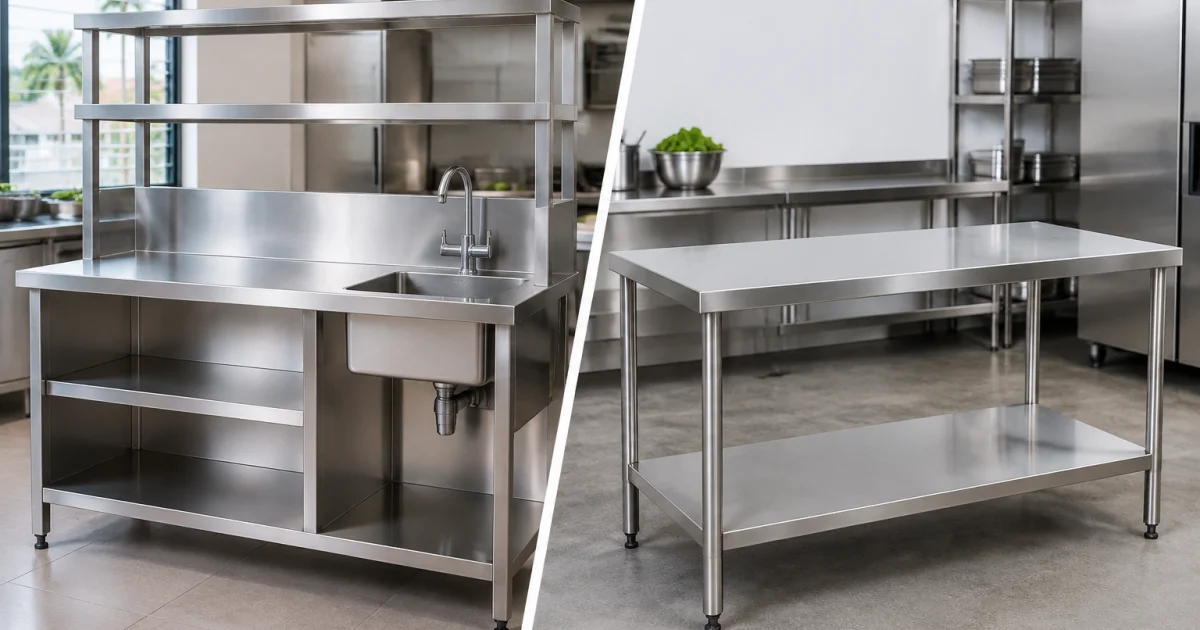
Custom stainless fabrication is built around your site conditions and how your team works. You can specify exact dimensions, material thickness, number of tiers, backsplash height, sink position, drainboard direction, cut-outs for equipment, and reinforcement for heavy appliances. Custom also covers integrated or purpose-built units like stall counters, pass-through benches, sink+worktable combinations, trolley bays, and enclosed bases designed around plumbing/electrical constraints.
The key point: custom isn’t “luxury” by default—often it’s a practical fix for layout and workflow problems.
Where off-the-shelf wins (and why it’s often the smarter first move)
Standard stainless is strong when you need speed, simple purchasing, and fewer variables.
1) Speed and predictability
Fixed specs make decisions faster and installations more straightforward. If you’re opening soon, adding a prep corner, or replacing damaged items, off-the-shelf reduces delays.
2) Easier budgeting and comparison
Catalogue items are easier to compare across suppliers because the specs are consistent—helpful when stainless must compete with refrigeration, cooking equipment, and other big-ticket needs.
3) “Good enough” for low-complexity tasks
For portioning, light prep, plating, packing, or holding small appliances, standard benches and shelves are often sufficient. A typical stainless steel working table Malaysia kitchens rely on is simply a flat top with an undershelf and optional backsplash.
4) Standardization across multiple outlets
If you operate multiple branches, standardized models simplify training, cleaning routines, maintenance, and replacement (reorder instead of redesign).
My opinion: If you’re unsure, use off-the-shelf for non-critical stations first. It’s easier to upgrade later than to live with the wrong custom unit for years.
Where custom fabrication wins (and when it pays back quickly)
Custom stainless delivers the most value when you face physical constraints or when small inefficiencies compound due to volume.
1) Space recovery in tight or awkward layouts
Many Malaysian kitchens have narrow aisles, odd corners, columns, drains, or door swings. Custom, wall-to-wall pieces can recover usable surface area that standard sizes leave as dead gaps.
2) Better workflow, fewer steps, fewer bottlenecks
Custom is most worthwhile when it removes daily friction at busy stations, for example:
- Integrated sink + prep + drainboard to keep washing and prep in one continuous flow.
- Cut-outs for drop-in bins or equipment so items sit stable and aligned.
- Pass-through counters sized to your tray system for plating/dispatch.
- Underbench storage built around your container sizes.
In high-volume operations, time saved per task can translate into real capacity gains.
3) Hygiene and cleaning outcomes
Design choices can make stainless easier or harder to clean. Custom fabrication can reduce dirt traps by minimizing gaps and unreachable corners, adding proper backsplashes, controlling splash zones around sinks, and aligning hose routing or floor drains.
Fact vs opinion: Fewer seams and hard-to-reach corners generally improve cleanability (fact). Hygiene benefits are often underweighted when deciding to go custom (opinion), especially for operations with strict QA.
4) Supporting heavy loads and specific equipment
If you’re placing mixers, grinders, slicers, countertop fryers, or other vibrating/heavy equipment on a bench, custom specs (thicker tops, bracing, gussets) can improve stability and reduce vibration.
The hybrid approach: how most kitchens should actually buy stainless
Hybrid purchasing usually wins. Use standard items where “standard” truly works, and reserve custom fabrication for stations that determine speed, hygiene, or fit.
- Buy off-the-shelf for: simple prep tables, generic racks, wall shelves, utility trolleys, and non-critical benches.
- Go custom for: odd-length runs, integrated sink stations, stall counters, pass counters, corner solutions, equipment islands with utilities, and any station where multiple tasks must happen in one footprint.
A practical way to control cost and risk: open with essentials (often standard), then optimize with custom after 1–3 months of real workflow data—where staff queue, which corners stay wet, what gets moved repeatedly. That feedback is more reliable than guesses during planning.
Decision checklist: 10 questions to choose correctly (without analysis paralysis)
If you answer “yes” to several custom triggers below, fabrication is likely worth it.
- Is there a space constraint? (tight aisle, column, door swing, low ceiling, awkward corner)
- Does plumbing/drain location force a specific sink position?
- Is this station used continuously during service? (prep, wash, pass, packing)
- Are staff making repeated extra steps because items don’t fit?
- Do you need integrated features? (bins, shelves, underslung compartments, cut-outs)
- Will a standard size leave unusable gaps?
- Do you expect frequent menu changes? (if yes, standard/modular may be safer)
- Do you need to match existing equipment heights exactly?
- Is cleaning currently difficult? (hard-to-reach corners, splash problems)
- Is the bench supporting heavy or vibrating equipment?
My opinion: For many SMEs, the best indicator isn’t “budget,” it’s “pain.” If a station causes daily frustration, custom often costs less than years of workarounds.
Buying smart in Malaysia: materials, fabrication details, and supplier coordination
Whether you buy standard or custom, a few habits prevent expensive mistakes.
Specify the details that affect durability
Clarify stainless grade expectations (often discussed as 304 vs 201), top thickness, safe edge finishing, and whether you need adjustable feet for uneven floors. Confirm how undershelves are supported. For wet zones, discuss corrosion risk and the cleaning chemicals you use so the recommendation matches real conditions.
Measure like an installer, not like a shopper
Measure beyond width and depth: door openings, piping, wall skirting, floor traps, and the clearance needed to pull equipment out for deep cleaning. Custom can solve clearance issues only if the measurements reflect actual obstacles.
Coordinate stainless with other equipment purchases
Bench height/depth affects access panels, ventilation gaps, and serviceability next to refrigeration, cooking lines, and beverage stations. If you’re sourcing multiple categories, coordinate the full layout so stainless doesn’t block airflow or maintenance access. In many builds, working with a one-stop commercial kitchen equipment supplier Malaysia operators rely on reduces clashes during installation.
Consider used and second-hand selectively (especially for standard pieces)
Second-hand stainless can be cost-effective when the item is standard-size, structurally sound (no wobble, cracked welds, deep dents), and not a critical hygiene bottleneck. Custom pieces are harder to buy used because they were built for someone else’s layout—so prioritize used for standard benches/racks, and keep custom for exact-fit stations.
Conclusion: choose the option that removes risk, then the option that removes friction
Off-the-shelf stainless is best for speed, predictable budgeting, and straightforward replacement. Custom fabrication is best when constraints, hygiene goals, or high-throughput workflow make “almost fits” too costly.
For most restaurants, cafes, hotels, caterers, and factories, the best outcome is hybrid: standardize what can be standardized, and fabricate what must be exact. When stuck between choices, reduce risk first (get operating), then remove friction (optimize the stations that slow the team down).
Useful next steps for planning your setup
- Explore stainless steel food stall and tea counter options if you need a front-of-house build that fits your service flow.
- Browse foodservice equipment to coordinate benches with holding, serving, and back-of-house support items.
- See bain marie selections if your pass counter or buffet line needs heat-holding integration.
- Review beverage equipment for cafes and drink stations that often benefit from custom counter layouts.
- Check catering equipment if you’re optimizing mobile or event-driven workflows.
Frequently Asked Questions
Is custom stainless steel kitchen equipment always more expensive than standard items?
Not always. Custom fabrication can cost more upfront, but it may reduce installation workarounds, recover usable space, and improve workflow at high-use stations. For simple tasks (basic prep benches, generic racks), off-the-shelf is often better value. Many businesses get the best cost-to-benefit by mixing standard items with a few custom “problem solvers.”
What should I check before ordering a stainless steel working table in Malaysia?
Confirm your available footprint (including door and aisle clearance), target working height, whether you need a backsplash, undershelf reinforcement, and adjustable feet for uneven floors. If heavy appliances will sit on it, discuss top thickness and bracing. Also consider how staff will clean around it and whether the table needs cut-outs or storage that a standard model may not provide.
When does stainless steel kitchen equipment fabrication make the most sense?
Fabrication is most useful when your layout is tight or irregular, when plumbing/drain locations dictate sink placement, or when you want to combine tasks into one footprint (wash + prep + drainboard, pass counter, stall counter). It also helps where hygiene is a priority and you want to reduce gaps, seams, and hard-to-reach corners.
Can I use second-hand stainless steel kitchen equipment for a new outlet?
Yes—especially for standard-size items like simple benches, racks, and shelves, provided the unit is structurally sound and easy to sanitize. Inspect for wobbling frames, cracked welds, deep dents, and sharp or poorly finished edges. For critical wet areas (sink stations) or exact-fit counters, custom or carefully selected new items are often safer.
Should I buy stainless from a general supplier or a one-stop commercial kitchen equipment supplier?
If you’re only replacing a bench, a focused stainless supplier may be enough. If you’re building or renovating a full kitchen, a one-stop commercial kitchen equipment supplier can reduce coordination issues—stainless heights, clearances, and access panels should match refrigeration, cooking equipment, and beverage or foodservice stations. The advantage is fewer clashes during installation and a smoother handover.
Plan the right mix of custom and standard stainless with Pearlmile
If you’re deciding between off-the-shelf benches and custom stainless fabrication, Pearlmile can help you choose what to standardize and what to build to fit. With over 26 years of experience, we support Malaysian F&B operators with one-stop commercial kitchen solutions—custom stainless steel worktables, counters, sinks and racks, plus refrigeration, cooking equipment, bakery machinery, food processing machines, and flexible options like used equipment, rental, and trade-ins.
Share your kitchen layout and workflow needs, and we’ll recommend a practical setup that balances lead time, hygiene, and budget.